
TL;DR
- General AI models now beat the robot specialists at robot judgment. In July, a robot-tuned Gemini led Google's own test of robot judgment. By October, three general models (Gemini 4 Argon, Claude Opus 5.5 and GPT-6 Astra) had passed it.
- General models lead on real robot arms too. On RobocurveA small group of AI testers that runs every new frontier model on two real robot arms, through the same set of tasks, and gives partial credit for progress.'s arms, the best general model scores 2.5 times more than the best robot model anyone can download, and only Dream-1 (a robot model sold through an API) scores higher. A bigger blind test, RoboColosseum, finds a smaller lead.
- OpenAI is back in robotics, and building its own humanoid. It quit in 2020 because there wasn't enough robot data, and now it's hiring engineers for its own motors.
- What's missing is speed and touch. The models think too slowly for a moving body, which we expect fixed by mid-2027. Touch needs 30 to 60 million hours of real-world data (our estimate), many times what exists today.
- The labs get paid for the brain, and everyone else fights for the rest. The bodies, the data and the robots at work (whose failures become training data) go to whoever builds and runs the robots.
- Our dates: a GPT-2 moment in February 2027, and a ChatGPT moment in November 2027. First a home robot under $10,000 does one or two chores in homes it has never seen. Then robots do basic chores right more than 90% of the time, with no remote pilot.
In August 2025, Wang Xingxing, the founder of Unitree (China's best-known robot maker), called VLAs (the robot models built on top of language models) "a relatively dumb architecture". He bet on another kind of AI instead: video world models, which learn physics by predicting what happens next in a video. In October, he put GPT-6 on his robots. "The results have actually been very good," he said, and then: "the biggest mistake I've made over the past decade or so has been not believing in AI enough." If things go fast, he added, GPT-7 "may" be the breakthrough for robots next year.
He wasn't the only one to change his mind this year. In one summer, the general AI models (the ones behind Gemini, Claude and ChatGPT) passed the models tuned for robots at robot judgment, first on Google's own test and then on real robot arms. And OpenAI, which quit robotics in 2020 because there wasn't enough data, came back to build its own humanoid.
So robots now have a brain, and it came from the labs. What they need next is the data that teaches a body to touch the world, and collecting it is what comes next.
The detour
To see why that surprised so many people, go back ten years. In June 2016, OpenAI published its technical goals. Goal 1 was to measure progress. Goal 2 was to "build a household robot", with a small note in brackets: "off-the-shelf; not manufactured by OpenAI".
Robotics was one of OpenAI's best-known projects. In 2019 its Dactyl project solved a Rubik's cube with a robot hand, after the equivalent of 13,000 years of practice in simulation. Then in October 2020, OpenAI stopped. Wojciech Zaremba, the co-founder who led the team, explained why. With language, pre-training (first learning from a huge pile of text) "allows to give model 100x cheaper IQ points", but robotics, he said, didn't have that kind of data. So the lab bet on language instead, where the internet had all the data it could eat.
Meanwhile, the idea of putting a language model in charge of a robot was growing at Google, before ChatGPT even existed. In 2022, Google's robotics team built SayCanGoogle's 2022 system: a language model suggests the next step, and a learned score says which steps the robot can actually do from where it is.: a language model chooses which of the robot's skills to use next. When the team swapped in a bigger language model, the robot got better too, and they called it "the first time we can see how an improvement in language models translates to a similar improvement in robotics." Next, Code as PoliciesGoogle's 2022 work where a language model writes the robot's control code itself, instead of picking from skills the robot already learned. had the model write the robot's control code itself. And in 2023, RT-2Robotics Transformer 2 (Google DeepMind, July 2023): a vision-language model trained on the web, then on robot data, so it outputs robot movements. It gave VLAs their name. had the model output the robot's movements directly, and named the result a "vision-language-action model" (a VLAVision-language-action model: one model that sees (vision), reads the instruction (language) and moves the robot (action).).
Then the group split up.1Alphabet had already shut down Everyday Robots (the unit whose robots SayCan ran on) in February 2023. It had more than 100 robots and 200 staff, and part of the team moved into Google Research. Google's core team stayed and built Gemini Robotics. Others left Google to start companies that build models only for robots. Karol Hausman, Sergey Levine, Chelsea Finn and Brian Ichter were among the founders of Physical Intelligence (PI). Two of the Code as Policies authors founded Generalist. And outside Google, Deepak Pathak (a Carnegie Mellon professor, who had co-written a paper on language models planning household tasks, even before SayCan) co-founded Skild AI.
They all came to the same conclusion: robots need their own data. Their models still started from a vision-language model (a language model that can also see images), and what they added on top was robot data.2π0 started from PaliGemma (Google's open vision-language model), and added an "action expert" that sends motor commands up to 50 times a second. The internet is full of text and images, and PI's first model, π0Physical Intelligence's first robot model (October 2024): a vision-language model with 3 billion parameters, plus an "action expert" that sends motor commands up to 50 times a second., came with a plain warning: "there is no such treasure trove of robot data."
For a while, they were right. In February 2025, PI's own planner (Hi Robot) beat GPT-4o at following robot instructions, 76 to 30 on PI's accuracy score. Figure ended its partnership with OpenAI that same month, and Brett Adcock (Figure's CEO) wrote: "For us, LLM's have quickly become the smallest piece of the puzzle."3His post of 5 February 2025: "LLMs are getting smarter yet more commoditized. For us, LLM's have quickly become the smallest piece of the puzzle." Figure shipped its own model, Helix, 15 days later. And in August 2025, Unitree's Wang Xingxing bet against VLAs altogether (the bet he now calls his biggest mistake).
The return
Then, in one summer, the general models came back for the job, and beat the robot specialists at robot judgment.
The July scores come from Google's own table for Gemini Robotics-ER 2, and the October scores from Google's post about Argon. Gemini Robotics-ER 2 is itself a Gemini, trained further for robots. Source: Google DeepMind, Gemini Robotics-ER 2, 30 Jul 2026; Google, Gemini 4 Argon for robotics, 13 Oct 2026
In July, Google's robot-tuned model (Gemini Robotics-ER 2) led ERQAEmbodied Reasoning Question Answering, Google DeepMind's test of robot judgment: multiple-choice questions about images and videos (what should the robot do next, where are things). No robot moves., Google's test of robot judgment, with 78.5. It was well ahead of Claude Opus 5 (67.2) and GPT-5.6 Sol (43.2). Three months later, Google reported 87.0 for its new general model, Gemini 4 Argon, with Opus 5.5 at 82.3 and GPT-6 Astra at 81.0. So Google's own general model beat Google's own robot specialist (a good problem to have, for Google).
Real robots showed the same jump. Robocurve tests each new model on two real robot arms, and gives partial credit for progress on each task. On its six easiest real tasks (out of 18, the ones where Astra did best), the best general model went from 14.9% in July to 48.2% in October.4Robocurve plots each model by its release date. Full completions (the robot finishes the whole task) are much lower: Argon fully finished 21 of its 120 attempts (17.5%). The rig is also turn-based (the arms wait while the model thinks), so speed doesn't count here. Robocurve's table gives the general models' best settings: Argon 48.2%, GPT-6 Astra 42.5%, GPT-6.1 Sol 41.7% and Opus 5.5 38.2% (Opus 5.5 reached about 48% at its extra-high effort setting, in Robocurve's October charts). The best open robot model (one anyone can download and run), MolmoAct2An open robot model from the Allen Institute for AI (anyone can download it). On Robocurve's real arms, it's the best open model built for robots., is at 18.9%. A robot model has just taken the lead, though: Dream-1, from Dream Labs (released on 19 October, and available only through an API), scores 59.3%. So on real arms, the robot specialists are still in the race.
A bigger test finds a smaller gap. RoboColosseum, published on 2 November, ran blind side-by-side trials at 124 sites, each pitting a general model against a robot model on the same task. Across 901 pairs, the general model made more progress in 394, the robot model in 265, and 242 were tied, an average lead of 5.3 points. Opus 5.5 and Astra led by 12 and 11 points, while Grok 4.7 trailed by 7.5.
The score gives partial credit for progress, so full completions are much lower. Robocurve's arms wait while the model thinks (so speed doesn't count here), and the six tasks are the ones, out of 18, where Astra did best. Scores are from Robocurve's table (Opus 5.5 is at 38.2% there, and reached about 48% at an extra-high effort setting in Robocurve's October charts). The grey lines are robot models on the same arms: MolmoAct2, the best open one (NVIDIA's GR00T N1.7 scores 9.5%), and Dream-1, which Dream Labs sells only through an API. The dashed line is an extrapolation: it assumes failures keep halving every 134 days, the pace from July to October. Source: Robocurve, table and reports, read 23 Oct 2026; extrapolation est.
In simulation, GPT-6 Astra completed 22% of RoboDojoA robot test in simulation, with 42 tasks and a public leaderboard. The physics pauses while the model thinks, so it measures skill, not speed.'s 42 tasks with no robot training at all. GPT-5.5, in the same harnessThe software around a model: it turns camera images into a prompt, and the model's answers into robot commands. The same model can score very differently with a better harness., completed under 1%.5A model built for robots took first place on RoboDojo's leaderboard on 8 October and kept it for six days, until coding agents running on Astra took it back. And COAP, a robot controller made only of code (written by Opus 5.5 agents), reached 70.24% with no AI model running while the robot moves (0.3 ms a step). So a coding agent can write a robot controller that scores well and runs very fast, with no AI model needed while it runs. And Argon learned the cornhole throw in the photo at the top of this page from one video of a person. It wrote its own physics simulation, practised there, and then adjusted its release on the real robot until it sank seven in a row.
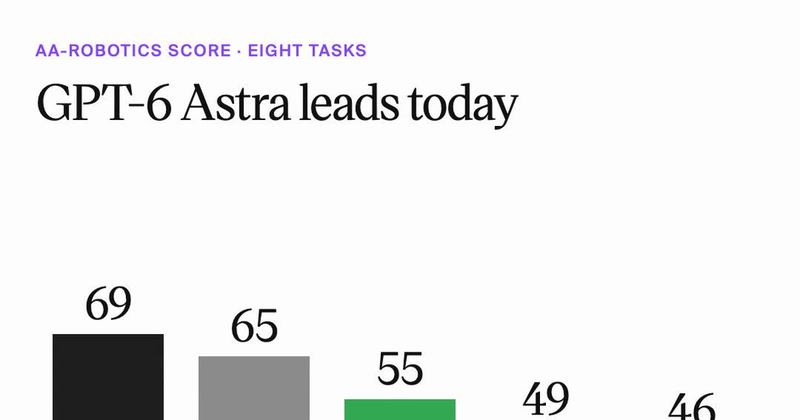
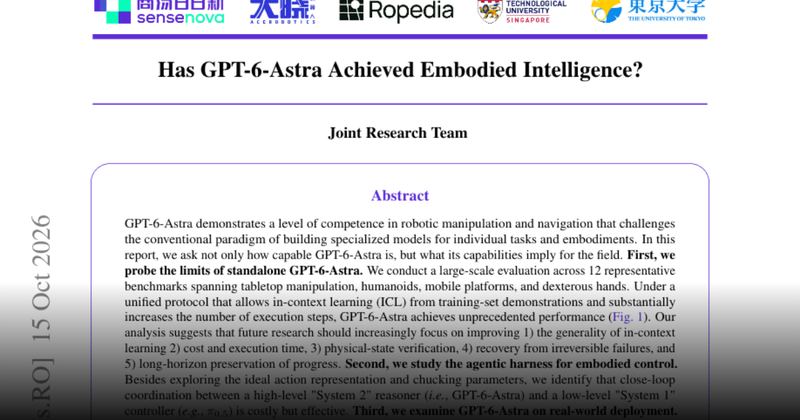
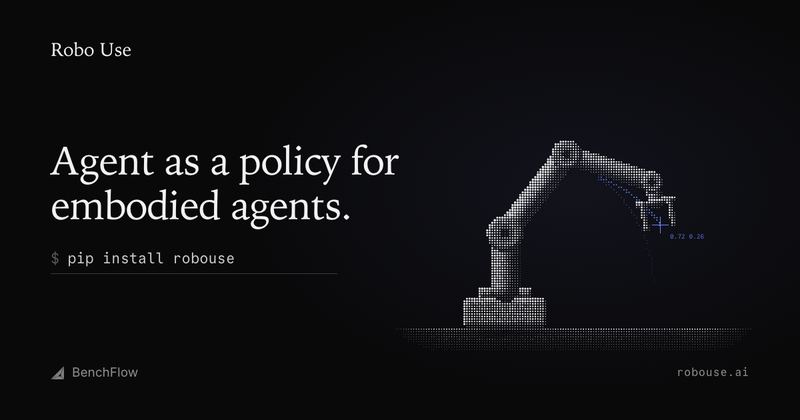
Here is every benchmark in this essay, what it tests and why it matters:


People in robotics noticed fast. Jim Fan, who co-leads NVIDIA's robotics lab, plugged Astra into his lab's agent framework (the software that connects a model to a robot), and it "saturated all the benchmarks to ~99% over night".6ASPIRE was already an agent framework built around a language model, and Fan swapped that model for Astra. The benchmarks were in simulation, and his colleague Guanzhi Wang's thread credits the ~99% on one of them (LIBERO-Pro) to Opus 5.5. He also wrote that Opus 5.5 "slightly edges out Astra on our robot simulation bench". Chris Paxton, at Agility, saw a "Crisis of faith among robotics people".7Paxton on 14 October: "There's still a hope for robotics-specific models." Two days later: "This sentiment has been more controversial than expected. Crisis of faith among robotics people." Earlier, on 6 October (answering a comparison of simulators), he had written that many simple tasks "can be done with a really stiff controller and no real interaction with world" (in other words, they need no real contact or physical skill).
And the lab that had quit came back. OpenAI's bet on language is what built the robot brain: the models trained on the internet turned out to be very good at deciding what a robot should do. On 1 September 2026, someone asked Sam Altman if OpenAI would build a humanoid, and he answered: "We will definitely do a humanoid." OpenAI Robotics launched in May, around the team behind Sora (OpenAI's video model), and it will "program and manufacture robots". In early November, five of its 15 open robotics jobs were for its own motors and actuators (the motor-and-gear units that move each joint). And what OpenAI needs now is exactly what it quit over in 2020: data from robots touching the world.
What can't the brain do yet?
The brain can't do touch yet, and it's too slow. What the general models brought is judgment: what an object is, what to do with it, in which order, and what to try when it fails. And every big lab has that now. Google, Anthropic and OpenAI are within 10 points of each other on Robocurve's arms, and what it costs to run the best model for one step of a task halved every three weeks over the summer (from $2.36 to $0.38).
What's missing is on the body's side. On real robots, Astra picked up rigid objects 17 times out of 18, but it inserted a plug 0 times out of 11. On precision tasks in simulation, the best robot model scores 35%, and Astra (with no robot training) 4%. Then there's speed, which gets solved by mid-2027 (more on that below). Today, when the world keeps moving while the model thinks, the models struggle. On Vals AIA company that tests AI models. Its robotics test keeps the physics running while the model thinks, so if the model is slow, the robot falls or fails.'s humanoid tasks (a simulation that doesn't pause for the model), no model scores even 2 out of 100. Argon took 152 seconds on average to send its first command, and each try only lasts 180 seconds.
Real arms: Robocurve's six real tasks, progress score. Moved objects: LIBERO-PRO, the same tasks with the objects moved. Precision: RoboDojo's tight insertions, in simulation. LIBERO: the benchmark the robot models were fine-tuned on, so they know its layout by heart. In SenseTime's tests on real robots, Astra picked up rigid objects 17 times out of 18, and inserted a plug 0 times out of 11. Vals AI keeps the physics running while the model thinks, while Robocurve's arms wait for it. Source: Robocurve; RAX, arXiv 2610.22496; RoboDojo leaderboard; BenchFlow Robo Use, Sep to Oct 2026
This is why every serious robot is built in layers: a big model thinks, and a small, fast one moves. SayCan did it in 2022, and so do Figure's Helix (its fast layer sends 200 commands a second), NVIDIA's GR00TNVIDIA's open robot models for humanoids (first released in March 2025). Like most robots, they split the work between a slow planner and a fast controller. and Google's own robot models. The open question is how much of the work the big model will take over from the small one. First, it writes the controller's code, builds the simulator and grades the practice runs. One day, it moves the joints itself.
Sergey Levine, PI's co-founder, explains the gap well. Language models, he wrote, are "the world's most powerful brain scanner" (they learned how people think by reading what people wrote). But "these AI systems live in Plato's Cave. The cave is the Internet." In other words, they learned the world from descriptions of it. And touch (the force on a fingertip, a cup starting to slip, the click of a connector) is mostly missing from those descriptions. For robots, he says, "real data is indispensable".
So the next race is for that data.
The last two rows are our estimates, and the first two are the companies' own figures. Generalist's hours come from grippers that people wear while they work, and it reportedly passed 500k hours by GEN-1. Source: Generalist (GEN-0, Nov 2025, reported); Nature Will, Natura-1, 13 Oct 2026; our estimates
Our estimate is that robots need 30 to 60 million hours of real-world data to reach GPT-4 level (as good at physical tasks as GPT-4 was at text). Today the world has 3 to 4 million hours of first-person video, the closest thing to it. The rest will come in three waves:
- Basic home tasks, from first-person video of people and from simulation. Nature Will's Natura-1, trained on a million hours of first-person video, already drives a five-finger hand.
- Precise tasks, from robots practising in factories and warehouses, with a check that scores each try automatically on contact.
- The long tail (the tasks with zero data today), from 2030.
Who gets paid?
The labs get paid for the brain, that much is clear. How the rest gets split depends on one question: will the frontier models only teach robots, or will they drive them too? Today they do both. They drive robot arms on benchmarks. And they teach: Argon produces thousands of simulated runs that are used to train robot models. A research team also shrank GPT-5.4 into a small model that kept 90% success on a real arm (the original had 93%), and ran seven times faster.
If the labs only teach, the value goes to whoever owns the body and the loop (robots at work, whose failures become training data). If they drive, it goes to the labs. Our view is that it's a split. By mid-2027 the big models get fast enough to think live, while the robot moves, so the labs keep the brain. But the lab's model won't do everything: under it, an action model trained on robot data moves the hands, and a controller trained in simulation keeps the body balanced. So everything except the brain (the bodies, the data and the loop) stays open for everyone else.
The first wave of AI apps went the same way. In March 2023, two weeks after GPT-4, Bloomberg published BloombergGPT, a model made for finance. By May, a study found that GPT-4 beat it on several finance tasks. In November, GPT-4 with good prompting beat Google's medical model, Med-PaLM 2. Both times, the specialist lost to the general model, and the specialists that survived owned something else. Harvey, the legal AI company, wrote in 2025: "In less than a year, seven models (including three non-OAI models) now outperform the originally benchmarked Harvey system" (OAI is OpenAI). Harvey survived thanks to the workflow lawyers use every day, and the data that comes with it.
In that first wave, the labs made a ton of money, and specialists like Harvey made money on top. Then the labs came for the applications too (Claude Code and Codex against Cursor). In robotics, the application is a body doing a job, and there's one more layer: the data. Here's how robotics splits:
1. The labs take the brain. OpenAI went from "not manufactured by OpenAI" in 2016 to "program and manufacture robots" in 2026. Its robotics job posts this autumn asked for people to run "deployed workcells" (robot stations collecting data in a live operation) and "exabyte-scale" robot training (a huge amount of robot data). Google never left. Boston Dynamics chose Gemini Robotics for Atlas in January, and Argon drove Apptronik's Apollo and a Spot in October. Aaron Saunders (Boston Dynamics' former CTO) is also building a DeepMind robot lab near Boston. The big labs will build the robot's brain, and the software that companies built around weak robot brains (the robot "operating systems") won't last long.
2. Robot model companies win if they own the loop. PI sells its API as "Frontier Models for Every Robot".8PI's February essay, "The Physical Intelligence Layer", says it wants roboticists to use π models "in the same way that developers use API-based LLMs". PI and Skild bet that action (moving a body well) is a frontier of its own, and their edge is data from robots at work. When Weave's laundry robots fed PI's training, the number of times a person had to step in fell by half. Skild says it passed a $100M run-rate, on hundreds of robots at more than 60 companies, and no lab has paying fleets like that yet. If the labs' models learn to move bodies too, the loop is what's left for these companies, like the workflow was for Harvey.
3. Whoever collects the data. If data is what's missing, collecting it pays. Data vendors already pay companies with big manual workforces (warehouses, kitchens, hotels) to film the work, and they sell the hours to the companies that build models.
4. Robots for one job. Startups build the robots that do one job, and the labs build the brain for the robot that does everything. FieldAI's models run many types of robots, and it sells one job: autonomy on construction and industrial sites ($135M+ in revenue and contracts, reported). Ultra packs warehouse orders with PI's models (500,000+ so far). So now is a great time to start a robot company for one job.

When do robots get their ChatGPT moment?
Robots get their ChatGPT moment in November 2027, once there are bodies to run on. ChatGPT launched on devices people already had (a phone, a laptop). Robots need bodies first, and the world's 5 million factory robots are mostly arms fixed in place and programmed for set jobs. As Ultra's Jon Schwartz says: "There cannot be a ChatGPT moment for robotics without robots." That's why the labs are building bodies.
Here are our dates:
- GPT-2 moment, February 2027: the first time it clearly works. A wheeled home robot under $10,000 does one or two chores in homes it has never seen.
- June 2027: the first independent review of a home robot with no remote pilot.
- ChatGPT moment, November 2027: robots become useful in any home. Basic chores (fetch, tidy, fold, load) done right over 90% of the time in homes the robot has never seen, with no remote pilot and a full shift on one charge.
- Claude Code moment, July 2030: robots are mostly skilled (like coding agents became with Claude Code), and mass adoption starts.
The curves back the November 2027 date. The speed gap is closing fast: between June and August, the fastest model at a given level of intelligence got 2.1 times faster every month. Today, on Artificial AnalysisAn independent company that tests AI models. Its robotics test (AA-Robotics) runs models on a real robot arm, and compares their success, time and cost with a person's.'s real-arm test, the robot is about 90 times slower than a person, and six more months at that pace closes most of that gap. On Robocurve, the best general model went from 42.5% (Astra, in September) to 48.2% (Argon, in October), so the next frontier model is the real test.
What to watch:
- The next frontier model on Robocurve. Argon leads the general models at 48.2%, and the next release should pass 50% (Dream-1, a robot model, is already at 59.3%).
- A real-robot test of π0.7 (PI's newest model), Gemini Robotics 2 and Figure's Helix, next to Argon.
- OpenAI's "deployed workcells" becoming fleets, and DeepMind's Boston lab ("stay tuned for more later in 2027!").
So the date now depends on the next few months. If the next frontier models pass 50% on Robocurve's real arms, and keep getting faster at the same pace, robots get their GPT-2 moment in February 2027 and their ChatGPT moment in November 2027. By then the brain will be ready, and the open race will be for the bodies, and for the data that only robots touching the world can collect.
Sources
Each TL;DR point is sourced under the section that develops it.
TL;DR and opening
- Wang Xingxing calls VLA "a relatively dumb architecture" (相对傻瓜式的架构) and backs the video route, August 2025: 36Kr, "聊模型的王兴兴", 13 Aug 2025; in English, with the speech date (9 Aug, World Robot Conference) and the world-model bet: 36Kr Europe, on Wang Xingxing's remarks, 12 Aug 2025
- Wang on GPT-6 ("very good"), GPT-7 that "may" break through next year, and "not believing in AI enough": Stockstar, Wang Xingxing at the China International Industry Fair, 12 Oct 2026; English translation: Zilan Qian on X, 12 Oct 2026
- Cover photo: Argon learns cornhole from one video of a person, codes its own simulation, Apollo sinks 7 in a row: Google DeepMind on X, 13 Oct 2026
The detour
- OpenAI's 2016 goals (Goal 1 "Measure our progress", Goal 2 a household robot, "off-the-shelf; not manufactured by OpenAI"): OpenAI, "OpenAI technical goals", 20 Jun 2016, archived
- Dactyl's Rubik's cube, "roughly 13 thousand years" of simulated experience: OpenAI (Akkaya et al.), "Solving Rubik's Cube with a Robot Hand", 16 Oct 2019
- OpenAI stopped robotics in October 2020, and Zaremba is a co-founder: VentureBeat, "OpenAI disbands its robotics research team", 16 Jul 2021; Zaremba headed robotics, "pre-training allows to give model 100X cheaper IQ points" and robotics hadn't had such data: Weights & Biases, Gradient Dissent, "What could make AI conscious?" with Wojciech Zaremba, Jun 2021
- SayCan: a language model picks the robot's next skill, the PaLM swap improves the robot, the "first time" quote, robots from Everyday Robots (footnote); its authors include Hausman, Ichter, Levine, Finn, and Carolina Parada and Kanishka Rao, who now sign Google's Gemini Robotics posts (below): Ahn et al. (Google), "Do As I Can, Not As I Say" (SayCan), arXiv, 4 Apr 2022, PaLM results added 16 Aug 2022
- Code as Policies: the model writes robot control code; authors include Pete Florence and Andy Zeng: Liang et al. (Google), "Code as Policies", arXiv, 16 Sep 2022
- RT-2 outputs robot actions directly and names "vision-language-action models (VLA)": Brohan et al. (Google DeepMind), RT-2 project page, 28 Jul 2023
- Footnote: Everyday Robots shut in February 2023, over 100 robots, over 200 staff, part of the team moved into Google Research: The Robot Report, "Alphabet closes Everyday Robots among layoffs", 24 Feb 2023
- Who founded what: Hausman, Levine, Ichter and Finn among PI's co-founders (Levine again later): WIRED, "Inside the Billion-Dollar Startup Bringing AI Into the Physical World", 14 Nov 2024; Pete Florence and Andy Zeng co-founded Generalist: The Robot Report, "Generalist raises $400M", 4 Jun 2026; Pathak is a Carnegie Mellon professor and Skild AI's co-founder and CEO: Deepak Pathak, CMU homepage, read Oct 2026
- Pathak co-wrote the paper on language models planning household tasks, January 2022 (SayCan came in April): Huang, Abbeel, Pathak, Mordatch, "Language Models as Zero-Shot Planners", arXiv, 18 Jan 2022
- π0: "There is no such treasure trove of robot data", built on a VLM, motor commands "up to 50 times per second"; footnote: initialized from PaliGemma, with a separate "action expert": Physical Intelligence, π0 launch post, 31 Oct 2024 and Black et al., π0 paper, arXiv, 31 Oct 2024
- Hi Robot beat GPT-4o on instruction accuracy, 76 to 30: Physical Intelligence, Hi Robot, 26 Feb 2025
- Figure ended its OpenAI deal in February 2025: TechCrunch, "Figure drops OpenAI in favor of in-house models", 4 Feb 2025; Adcock's "smallest piece of the puzzle" post (footnote text): Brett Adcock on X, 5 Feb 2025
- Footnote: Helix, Figure's own model, announced 20 Feb 2025; its fast layer runs at 200 Hz (used again in "What can't the brain do yet?"): Figure, "Helix: A Vision-Language-Action Model for Generalist Humanoid Control", 20 Feb 2025
The return
- July ERQA: Gemini Robotics-ER 2 78.5, Opus 5 67.2, GPT-5.6 Sol 43.2; ER 2 is "a high-level brain" that hands motor work to a lower-level VLA (the layers, next section): Google DeepMind, Gemini Robotics-ER 2 page, Jul 2026; release date, and Gemini Robotics 2 under "What to watch": Google DeepMind (Carolina Parada), "Gemini Robotics 2 brings whole body intelligence to robots", 30 Jul 2026
- October ERQA: Argon 87.0, Opus 5.5 82.3, Astra 81.0; also, for "Who gets paid?", Argon exports 4,500+ simulated episodes for VLA training and drives a Boston Dynamics Spot: Google Developers Blog (Kanishka Rao), "Gemini 4 Argon for Robotics", 13 Oct 2026
- Robocurve on two real arms with partial credit: GPT-5.6 Sol 14.9% (July), GPT-6 Astra 42.5%, GPT-6.1 Sol 41.7%, Opus 5.5 38.2% (at high effort), Argon 48.2%, MolmoAct2 18.9%, Dream-1 59.3%, scores plotted by release date; the six tasks are the easiest of 18, picked by Astra's results; footnote: Argon's 21 full completions in 120 attempts (counted from the public run file): Robocurve, results table, read 21 Oct 2026, Robocurve, "Opus 5.5 on RoboDojo-RC Tier 1", 23 Sep 2026, Robocurve, public run file; footnote: the arms stand still while the model thinks: Robocurve, Inspect Robots agent plugin README, GitHub
- RoboColosseum's open track (blind paired trials at 124 sites; "Across 901 paired evaluations, agents achieve greater progress in 394 comparisons, VLAs in 265, and the remaining 242 are tied", "an average agent advantage of 5.3 percentage points"; Opus 5.5 and Astra 12.1 and 11.0 points ahead, Grok 4.7 7.5 behind): Nguyen, Wang, Duan et al., "RoboColosseum: Evaluating Physical Intelligence at Scale In-The-Wild", arXiv 2611.02497, 2 Nov 2026, section 4.2
- Dream-1, Dream Labs' robot model, released on 19 October and offered through an API: The AI Insider, "Dream Labs raises $90M in seed funding to build foundation models for any robot", 19 Oct 2026
- Argon "tied with Opus 5.5" (Opus 5.5 at its extra-high effort setting); MolmoAct2 "19% vs Gemini 4 Argon at 48%" (the 2.5x in the TL;DR): Jay Chooi (Robocurve) on X, 14 Oct 2026 and follow-up, 14 Oct 2026
- Astra 22.48% on RoboDojo's 42 simulated tasks with no robot training, GPT-5.5 0.88% in the same harness: Zhang et al., "An Unexpected Robot Policy: Early Evaluations of GPT-6 Astra on RoboDojo and Beyond", arXiv, 21 Sep 2026
- Footnote: VPP2 (a robot model) took first place on 8 Oct, EmbodiedEvo (coding agents on Astra) on 14 Oct; also the precision scores in the next section (VPP2 35.17%, Astra 4%): RoboDojo, leaderboard and news log, read Oct 2026 and Einsia AI on X, 14 Oct 2026
- Footnote: COAP, code written by Opus 5.5 agents, 70.24% with no model at test time, 0.3 ms a control step: Hu et al., "Embodied Turing Machines" (COAP), arXiv, 8 Oct 2026
- Cornhole: one video of a person, its own MuJoCo simulation, release adjusted on the real robot until seven went in straight: Google DeepMind, "Teaching a humanoid robot to play cornhole with Gemini 4 Argon", YouTube, 13 Oct 2026
- Jim Fan co-leads NVIDIA's GEAR lab: NVIDIA Research, GEAR lab page, read Oct 2026; ASPIRE, an agentic framework, switched its backend to Astra and "saturated all the benchmarks to ~99% over night"; footnote: "Opus 5.5 slightly edges out Astra on our robot simulation bench": Jim Fan on X, 16 Oct 2026; the benchmarks are simulation ones (LIBERO-Pro, Robosuite, BEHAVIOR-1K): Guanzhi Wang (NVIDIA) on X, ASPIRE thread, 16 Oct 2026
- Paxton (AI at Agility, per his profile) and the footnote quotes: Chris Paxton on X, 14 Oct 2026, 16 Oct 2026, "stiff controller", 6 Oct 2026
- Altman on 1 September, "We will definitely do a humanoid": Humanoids Daily, "Sam Altman Confirms OpenAI 'Will Definitely Do a Humanoid'", 2 Sep 2026, from Alex Heath, Sources podcast with Sam Altman, YouTube, 1 Sep 2026 (chapter at 58:22)
- OpenAI Robotics launched in May from Aditya Ramesh's world-simulation program, to "program and manufacture robots": Sam Altman on X, 31 May 2026; the Sora research team had gone on to world-simulation research "to advance robotics": CNN, "OpenAI is shutting down its Sora video app just months after launch", 24 Mar 2026
- 15 open robotics roles on 3 November (14 on the Robotics team, plus a robotics safety manager), five of them for motors and actuators: OpenAI job board (Ashby), read 3 Nov 2026; for "Who gets paid?", this autumn's "deployed workcells" and "exabyte-scale" robotics posts (19 robotics roles then): OpenAI job board (Ashby), archived 15 Oct 2026; live post: OpenAI, Field Engineer, Robotics, read 21 Oct 2026
What can't the brain do yet?
- Cost per robot subtask "halved every 3 weeks", $2.36 (July) to $0.38 (September); the labs within 10 points comes from the Robocurve table above: Robocurve on X, 13 Oct 2026
- Astra on real robots: rigid pick-and-place 17 of 18, plug insertion 0 of 11: SenseNova Joint Research Team, "Has GPT-6-Astra Achieved Embodied Intelligence?", 15 Oct 2026
- The physics keeps running while the model thinks; no model reaches 2 on the humanoid tasks; Argon 152 s to its first move; three-minute episodes: Vals AI, Robo-bench, updated 13 Oct 2026
- Layers: GR00T's slow vision-language module over a fast action module: NVIDIA, "GR00T N1", arXiv, 18 Mar 2025; Google's cloud backbone over an on-robot action decoder at 50 Hz: Google DeepMind, "Gemini Robotics: Bringing AI into the Physical World", arXiv, 25 Mar 2025
- Levine: "the world's most powerful brain scanner", "these AI systems live in Plato's Cave", "The cave is the Internet": Sergey Levine, "Language Models in Plato's Cave", 8 Jun 2025; "real data is indispensable": Sergey Levine, "Sporks of AGI", 21 Jul 2025
- Natura-1, trained on over a million hours of first-person human video, drives 20-DoF Wuji hands: Nature Will, "Natura-1: The Will to Act", Oct 2026; the Wuji hand has five fingers: Humanoid.guide, WUJI HAND 2, Aug 2026; Generalist's GEN-0, trained on 270,000+ hours of real manipulation data (an input to the estimate below): Generalist, "GEN-0: Embodied Foundation Models That Scale with Physical Interaction", 4 Nov 2025
- 30-60 million hours needed, 3-4 million hours of first-person video today, the three waves (long tail from 2030), and speed solved by mid-2027 are our own estimate and forecast, extended from the data stocks and scaling results of Natura-1 and GEN-0 and the speed trend below.
Who gets paid?
- A GPT-5.4 teacher distilled into a 4B student: 90.0% vs 93.3% on a real arm, calls 7.1 times faster: Liu et al., "Guava: Distilling Frontier VLMs into a Compact Agent", arXiv, Jun 2026
- "Our view is that it's a split" (labs keep the brain by mid-2027, an action model and a simulation-trained controller underneath, robot "operating systems" fading) is our own forecast, built on the speed trend below and the layered designs above (Helix, GR00T, Gemini Robotics).
- GPT-4 announced 14 Mar 2023: OpenAI on X, 14 Mar 2023; BloombergGPT, a finance model, 16 days later: Wu et al. (Bloomberg), "BloombergGPT: A Large Language Model for Finance", arXiv, 30 Mar 2023; GPT-4 beat BloombergGPT on several finance tasks (not on entity extraction), May 2023: Li et al. (JPMorgan AI Research), "Are ChatGPT and GPT-4 General-Purpose Solvers for Financial Text Analytics?", arXiv, 10 May 2023
- GPT-4 with Medprompt "outperforms ... Med-PaLM 2": Nori et al. (Microsoft), "Can Generalist Foundation Models Outcompete Special-Purpose Tuning?", arXiv, 28 Nov 2023
- Harvey's "seven models ... now outperform" line: Harvey, "Expanding Harvey's Model Offerings", 13 May 2025
- The labs' own coding apps: Anthropic, "Claude 3.7 Sonnet and Claude Code", 24 Feb 2025 and InfoQ, OpenAI launches Codex, a cloud software engineering agent, 19 May 2025
- Boston Dynamics puts Gemini Robotics on the new Atlas, January 2026: Boston Dynamics, "Boston Dynamics & Google DeepMind Form New AI Partnership", 5 Jan 2026
- DeepMind's new Boston-area robotics lab, "stay tuned for more later in 2027!" (also under "What to watch"): Aaron Saunders on LinkedIn, 12 Oct 2026; Saunders was Boston Dynamics' CTO, and the lab is in Watertown: Boston Globe, "Robots are coming to Watertown as Google announces a new 35,000-square-foot lab", 15 Oct 2026
- "Frontier Models for Every Robot", and the photo caption (partners' arms, wheeled robots and an autonomous wheel loader): Physical Intelligence, "Frontier Models for Every Robot: Announcing our API beta", 13 Oct 2026; footnote: π models used "in the same way that developers use API-based LLMs"; Weave's data in pre-training cut interventions by 50%: Physical Intelligence, "The Physical Intelligence Layer", 24 Feb 2026
- Skild's $100M run-rate, more than 60 customers, hundreds of robots (first reported by Bloomberg on 10 Sep): Silicon UK, on Skild AI's revenue run-rate, 14 Sep 2026
- Vendors pay businesses (warehouses, cleaning, restaurants) for video of their staff at work and license it to AI and robotics companies: Mercor, robotics data page, read Oct 2026 and TechCrunch, "Human Archive taps into India's services startups to collect data for physical AI", 26 May 2026
- FieldAI's software runs humanoids, robot dogs, drones and rovers; $135M+ in revenue and contracts, customers in construction, data centers and defense (Business Insider, 2 Oct): Dealroom, "FieldAI set to raise $700M at $10B valuation for its robot brain", Oct 2026
- Ultra's robots run on PI's models and have packed more than half a million orders: Fortune, "Ultra raises $62 million for fast-growing 'robots as a service' business", 9 Oct 2026
When do robots get their ChatGPT moment?
- 5 million factory robots at work: IFR, "Five million robots now operate in factories globally", 24 Sep 2026
- Schwartz's quote: Jon Schwartz (Ultra) on X, 9 Oct 2026
- The fastest model at "Fable 5-level" intelligence got 2.1 times faster a month (Fable 5 on 9 Jun to Gemini 3.7 Flash on 13 Aug): Robocurve, LLM token-speed data, snapshot 20 Aug 2026
- About 30 minutes a task against a person's 20 seconds (about 90 times slower): Artificial Analysis, "Welcome to the era of embodied AI: Introducing AA-Robotics v0.1", 14 Oct 2026
- π0.7, PI's newest model: Physical Intelligence, "π0.7: a Steerable Model with Emergent Capabilities", 16 Apr 2026
- Our dates (GPT-2 moment February 2027, first review with no remote pilot June 2027, ChatGPT moment November 2027, Claude Code moment July 2030), the "six more months" (ln 90 / ln 2.1, about 6) and "the next release should pass 50%" are our own forecast, built from the Robocurve curve, the token-speed trend and AA-Robotics' time gap above. Astra's 42.5% and Argon's 48.2% are from the Robocurve table above.
Notes
- Alphabet had already shut down Everyday Robots (the unit whose robots SayCan ran on) in February 2023. It had more than 100 robots and 200 staff, and part of the team moved into Google Research.
- π0 started from PaliGemma (Google's open vision-language model), and added an "action expert" that sends motor commands up to 50 times a second.
- His post of 5 February 2025: "LLMs are getting smarter yet more commoditized. For us, LLM's have quickly become the smallest piece of the puzzle." Figure shipped its own model, Helix, 15 days later.
- Robocurve plots each model by its release date. Full completions (the robot finishes the whole task) are much lower: Argon fully finished 21 of its 120 attempts (17.5%). The rig is also turn-based (the arms wait while the model thinks), so speed doesn't count here. Robocurve's table gives the general models' best settings: Argon 48.2%, GPT-6 Astra 42.5%, GPT-6.1 Sol 41.7% and Opus 5.5 38.2% (Opus 5.5 reached about 48% at its extra-high effort setting, in Robocurve's October charts).
- A model built for robots took first place on RoboDojo's leaderboard on 8 October and kept it for six days, until coding agents running on Astra took it back. And COAP, a robot controller made only of code (written by Opus 5.5 agents), reached 70.24% with no AI model running while the robot moves (0.3 ms a step). So a coding agent can write a robot controller that scores well and runs very fast, with no AI model needed while it runs.
- ASPIRE was already an agent framework built around a language model, and Fan swapped that model for Astra. The benchmarks were in simulation, and his colleague Guanzhi Wang's thread credits the ~99% on one of them (LIBERO-Pro) to Opus 5.5. He also wrote that Opus 5.5 "slightly edges out Astra on our robot simulation bench".
- Paxton on 14 October: "There's still a hope for robotics-specific models." Two days later: "This sentiment has been more controversial than expected. Crisis of faith among robotics people." Earlier, on 6 October (answering a comparison of simulators), he had written that many simple tasks "can be done with a really stiff controller and no real interaction with world" (in other words, they need no real contact or physical skill).
- PI's February essay, "The Physical Intelligence Layer", says it wants roboticists to use π models "in the same way that developers use API-based LLMs".